How to Watch the 2025 Beaver Moon Supermoon
How to Watch the 2025 Beaver Moon Supermoon
November’s full Moon is known as the Beaver Moon, and in 2025 it will also be a supermoon. It reaches peak illumination on November 5, 2025, at 13:19 Coordinated Universal Time (UTC)—8:19 a.m. Eastern Standard Time, 7:19 a.m. Central Standard Time, 6:19 a.m. Mountain Standard Time, and 5:19 a.m. Pacific Standard Time.
Because the exact moment occurs during daylight across much of North America, the best practical viewing opportunity will be the evening of November 4, around local moonrise. The Moon will also appear nearly full on November 5.
When Is the Beaver Moon?
The 2025 Beaver Moon reaches full phase at:
- UTC: November 5 at 13:19
- EST: November 5 at 8:19 a.m.
- CST: November 5 at 7:19 a.m.
- MST: November 5 at 6:19 a.m.
- PST: November 5 at 5:19 a.m.
Full phase is an exact astronomical moment, occurring when the Moon lies opposite the Sun from Earth’s perspective. The Moon does not suddenly become full or disappear after that moment. It appears nearly full during the surrounding evenings.
The best viewing nights are:
- November 4: The Moon rises shortly before full phase and should look full to most observers.
- November 5: The Moon will be past peak illumination but remain nearly full and bright.
- November 6: The Moon will still be prominent, although its illuminated shape will begin to look slightly less complete.
Check a location-specific lunar calendar or astronomy app for local moonrise times. Mountains, buildings, trees, and coastal terrain can delay the moment the Moon becomes visible.
Where and When to Watch
Plan to arrive 20 to 30 minutes before local moonrise. The Moon generally rises in the eastern part of the sky, although its exact position depends on the date, latitude, and local horizon. A compass or skywatching app can help identify the approximate direction.
An unobstructed eastern horizon is more important than finding the darkest possible location. Parks, beaches, lakeshores, hilltops, open fields, and safe balconies can all provide good views. Urban observers can still enjoy the Moon because it remains visible through moderate light pollution. Move away from direct streetlights to reduce glare.
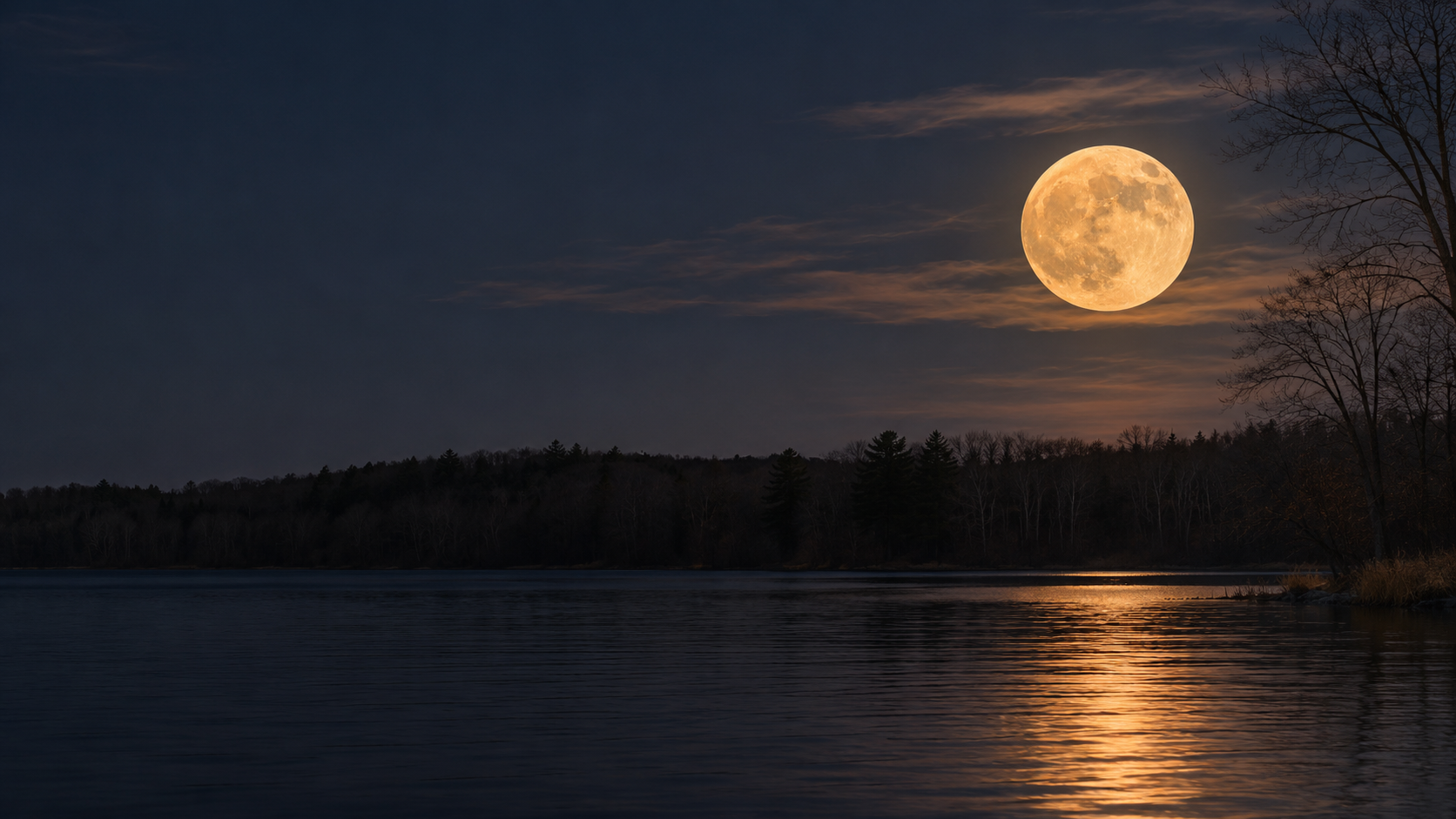
The Moon may look especially large near the horizon beside trees, buildings, hills, or distant landmarks. This is the Moon illusion. The Moon’s physical size does not increase near the horizon; the surrounding landscape changes how the brain judges its scale.
Later in the evening, the Moon will climb higher and may appear steadier through binoculars or a telescope because it is viewed through less turbulent air.
Why Is It a Supermoon?
A supermoon occurs when a full Moon happens near perigee, the closest point to Earth in the Moon’s elliptical orbit. “Supermoon” is a popular descriptive term, not a separate lunar phase.
Because the Moon is closer to Earth, it can appear roughly 7 percent larger and about 15 percent brighter than an average full Moon, depending on the comparison. The difference is modest and difficult to detect without side-by-side photographs. Atmospheric conditions, light pollution, and the Moon’s position can affect perceived brightness more strongly.
November’s Beaver Moon begins a sequence of four consecutive full supermoons. The sequence continues with full Moons in December 2025, January 2026, and February 2026. Different organizations may use slightly different distance thresholds when identifying supermoons.
Why Is It Called the Beaver Moon?
“Beaver Moon” is a traditional name for November’s full Moon. Several explanations connect it with seasonal beaver activity and winter preparation. As temperatures fall, beavers repair lodges, reinforce dams, and gather food. Historical accounts also associate November with setting beaver traps when the animals’ winter coats were valuable.
The name has no single universally confirmed origin. Full-Moon names vary among cultures and communities, and November names may also refer to frost, snow, hunting, winter preparation, or the end of autumn. These labels should not be treated as universal terms used by every Indigenous nation or historical community.
How to Watch the Beaver Moon
With the Naked Eye
No equipment is required. Find a stable location with a clear horizon, arrive before moonrise, and allow several minutes for your eyes to adjust to darker surroundings. A chair or blanket can make a long viewing session more comfortable.
The full Moon is safe to observe with the naked eye. Eye protection is necessary for solar observation, not ordinary lunar viewing.
With Binoculars or a Telescope
Binoculars can reveal craters, mountain ranges, bright impact-crater rays, and dark maria—the broad volcanic plains often called lunar seas. Begin with a low-power view that includes the entire lunar disk, then increase magnification after the image is focused and stable.
The full Moon’s brightness can make faint galaxies, nebulae, and star clusters harder to see. New-Moon periods are usually better for deep-sky observing.
Photographing the Moon
For a smartphone:
- Stabilize the phone against a tripod, railing, or solid surface.
- Tap the Moon to focus.
- Reduce exposure if the lunar surface looks white and featureless.
- Use a timer to prevent movement.
- Include a foreground object to show scale.
For a dedicated camera, start with a tripod, low ISO, and a fast shutter speed. Long exposures can overexpose the Moon and erase its surface detail. Use exposure bracketing when photographing both the Moon and a dark foreground.
A long telephoto lens is useful for lunar detail. A shorter lens works better for including buildings, trees, or people.
Staying Safe and Comfortable
Check the forecast for temperature, wind, cloud cover, visibility, and precipitation. Wear warm layers and bring a charged phone, a flashlight—preferably with a red-light mode—water, and any needed camera or binocular equipment.
Choose a legal, accessible location. Avoid roadsides, unstable cliffs, railway lines, private property, and unlit areas without preparation. Tell someone where you are going if the site is remote.
Beaver Moon Viewing Checklist
- Check the local moonrise time.
- Find a clear eastern horizon.
- Review the weather forecast.
- Arrive 20 to 30 minutes early.
- Bring warm clothing and a charged phone.
- Use binoculars or a camera if available.
- Avoid direct streetlights.
- Include a foreground object in photographs.
- Try the previous or following evening if clouds interfere.
Frequently Asked Questions
When is November’s Beaver Moon?
The 2025 Beaver Moon reaches peak illumination on November 5 at 13:19 UTC. Local moonrise and the best viewing time depend on your location.
What time is best for seeing it?
Watch around local moonrise, especially on the evening of November 4. The Moon will appear near the horizon beside buildings, trees, and distant landmarks.
Will it look bigger than a normal full Moon?
Slightly. Because it occurs near perigee, it can appear somewhat larger and brighter than a more distant full Moon. The difference is modest.
Can I see it without a telescope?
Yes. The Moon is easily visible to the naked eye when it is above the horizon and not blocked by clouds or terrain.
What if clouds block the Moon?
Try the previous or following evening. The Moon often appears nearly full for several nights. Check the updated forecast and local moonrise time before going outside.
Make the Most of the Beaver Moon
Check local moonrise, choose a safe location with an unobstructed eastern horizon, and arrive before the Moon appears. November 4 should provide an especially strong view, while November 5 offers another opportunity after full phase.
The Beaver Moon is November’s traditional full-Moon name and a supermoon in 2025. It also begins a four-moon supermoon sequence that continues into early 2026.
Related Articles
-
 How to See November’s Beaver Moon Supermoon
-
 Voyager 1 Faces New Data Glitch in Historic Mission
-
 BepiColombo Mercury Arrival Clouded by Thruster Glitch
-
 Nature vs. Nurture: How Much Do Genes Matter?
-
 Voyager 1 Reaches a Reported One Light-Day From Earth
-
 17 Best Voyager 1 Photos and Why They Matter
-
 How the Brain Represents Meaning Across Languages
-
 Renewed Rifting Detected Beneath Southern Africa
-
 Stonehenge’s Altar Stone Came From Scotland, Not Wales
-
 Earth’s New Mini-Moon 2026 QQ8: How Long Will It Stay?
-
 Why Russia’s Routine ISS Resupply Mission Draws Attention
-
 BepiColombo Mercury Arrival Uncertain After Software Issue
-
 Possible Second Earth-Like World Beyond Neptune
-
 2,000+ Arthropod Species Found in North American Homes
-
 Rare Triple-Star System 28 Light-Years Away
-
 BepiColombo Has Not Yet Entered Mercury’s Orbit