Ukrainian Drones and the Reported Russian Ship Strike in Libya
Ukrainian Drones and the Reported Russian Ship Strike in Libya
Reports from WRAL, The Associated Press, Audacy, and The Daily Review claim that Ukrainian naval drones struck a newly deployed Russian warship in Libya. If confirmed, the incident would extend the strategic reach of the Russia-Ukraine conflict into the Mediterranean and raise new questions about Russia’s military presence in North Africa.
The claim remains preliminary. The supplied reports do not identify the vessel, confirm its precise location, establish the extent of damage, or provide independently verified video or satellite imagery. One listing from The Daily Review gives a publication date of November 23, 2026, but that date cannot be independently confirmed from the supplied material Source 9.
What the Reports Claim
The available accounts make the same broad claim: Ukrainian naval drones struck a new Russian warship reportedly deployed to Libya. WRAL, AP News, Audacy, and The Daily Review describe the incident within wider coverage of Middle East developments Source 1.
The summaries do not establish the date or time of the alleged attack, the drones’ launch point, the ship’s exact location, or the immediate outcome. It is also unclear whether the vessel was struck in port, near the Libyan coast, or elsewhere in the Mediterranean.
AP News describes the vessel as a “new Russian warship,” while other summaries use similar wording Source 5. “New” could mean recently commissioned, newly transferred to a fleet, or recently arrived in Libyan or Mediterranean waters. A report that drones “struck” a ship also does not prove that it was destroyed, disabled, or removed from service.
What Is Known About the Warship?
The supplied summaries do not identify the ship’s name, class, mission, or operator. Those details should not be added until confirmed by the original reports, Russian or Ukrainian statements, satellite imagery, maritime tracking data, or other authoritative evidence.
Several outcomes remain possible:
- The drones may have directly hit the vessel.
- Explosions may have occurred nearby without causing significant damage.
- The ship may have been damaged but remained operational.
- The attack may have been claimed without visual confirmation.
- The report may have confused a ship’s arrival or movement with a confirmed strike.
Satellite imagery could reveal burn marks, a changed position, visible damage, or emergency activity. Commercial tracking data might clarify the ship’s movements, although military vessels often disable or manipulate public tracking signals.
No supplied source confirms casualties, flooding, sinking, or permanent loss. Those outcomes should not be stated as fact.
Ukrainian Naval Drones
Naval drones are uncrewed surface vessels that operate on water without a crew aboard. Depending on their design, they can conduct surveillance, reconnaissance, communications, mine-related missions, or attacks against ships and port infrastructure.
Ukraine has used maritime drones as an asymmetric capability because they can threaten larger and more expensive naval platforms at comparatively low cost. Their potential advantages include:
- Reduced danger to human operators.
- Lower cost than conventional warships.
- The ability to approach defended coastlines.
- A small visual and radar profile.
- The ability to attack ships in harbor or near naval facilities.
- Pressure on an opponent to invest heavily in coastal defenses.
A drone attack can affect operations even without destroying its target. Naval forces may disperse ships, increase patrols, deploy barriers, improve surveillance, and restrict port access.
The existence of naval drones does not establish how this particular attack occurred. The route, launch location, communications system, targeting process, and operational support remain unknown.
Why Russia Might Use Libya
Libya occupies a strategically important position on the southern Mediterranean. Its coastline faces southern Europe, while its territory offers access to North Africa, the central Mediterranean, and routes toward the Sahel.
Russia has pursued regional influence through military cooperation, political relationships, energy interests, and security partnerships. A naval or logistical presence in Libya could support several objectives:
- Resupplying ships operating in the Mediterranean.
- Moving personnel and equipment.
- Supporting Russian activity in Africa.
- Monitoring maritime traffic.
- Demonstrating influence near Europe and North Africa.
- Providing an alternative to facilities elsewhere in the region.
The supplied summaries do not establish the purpose of the reported deployment. A warship could support patrols, transport, deterrence, logistics, or another military mission.
Libya’s political fragmentation complicates any assessment of foreign military activity. A ship’s presence in Libyan waters does not show which authority authorized it, whether a formal agreement exists, or whether the deployment has broad political support.
A sustained Russian naval presence could concern European governments, NATO members, and Mediterranean states. It could affect maritime surveillance, arms transfers, migration routes, energy infrastructure, commercial shipping, access to ports and airfields, and military activity near Europe’s southern flank.
The Mediterranean and the Ukraine War
The Russia-Ukraine conflict has increasingly involved maritime operations, long-range strikes, attacks on logistics, and contested shipping routes. The Black Sea remains central, but its strategic consequences extend into the Mediterranean and beyond.
If the Libya report is confirmed, it could show that Ukraine can target Russian military assets far from the main front. Russia might then need to reconsider how it moves and protects ships outside its home waters.
Possible responses could include:
- Stronger air and coastal defenses.
- More frequent patrols around ports.
- Changes in naval movement patterns.
- Escorts or decoy measures.
- Less public information about naval movements.
- Pressure on local partners to improve security.
The effect would depend on the damage. A failed attack could still expose weaknesses, while a successful attack against a valuable platform could produce a larger military and political response.
One reported strike does not prove that a permanent new theater of war has opened in Libya. It does show why overseas deployments can become vulnerable when a conflict involves long-range weapons and uncrewed systems.
Implications for Russia and Ukraine
Russian Naval Deployments
If confirmed, the incident could force Russia to reassess the risks of using Mediterranean ports and support facilities. Ships that previously operated with limited exposure might require additional defenses, surveillance, and movement restrictions.
The impact would be greater if the targeted vessel performed a specialized mission or belonged to a limited class of high-value ships. Damage could reduce Russia’s operational flexibility and force it to divert other vessels from existing tasks.
The report could also affect Russia’s relationships in North Africa. Local authorities may face pressure to improve port security or clarify their role in hosting foreign military assets. Russia could instead seek greater control over facilities and security arrangements.
Ukraine’s Long-Range Strike Strategy
Ukraine has relied on asymmetric capabilities to challenge Russia’s military advantages. Naval drones fit this approach because they can threaten major platforms without requiring Ukraine to match Russia ship for ship.
A successful strike against a Russian warship in Libya would have a significant psychological effect. It could demonstrate that distance and geographic separation do not guarantee safety and could influence planning in other regions where Russian vessels operate.
The operation would also involve substantial challenges. A long-range maritime mission requires navigation, intelligence, communications, target identification, and the ability to move through defended or congested waters. Weather, commercial traffic, electronic warfare, and coastal surveillance could all affect the result.
The available material does not explain how the drones reached the reported location. Speculation about launch sites or outside assistance should not be treated as fact.
Escalation Risks
If confirmed, the report could increase escalation risks. Possible consequences include intensified Russian attacks on Ukrainian infrastructure, pressure on facilities suspected of supporting Ukrainian operations, and greater military activity around Libya and the central Mediterranean.
Other risks include disputes over territorial waters, foreign bases, port access, and responsibility for attacks. Commercial shipping could face higher insurance costs or additional security requirements if operators believe military activity is spreading.
The most serious danger would be miscalculation. A strike involving a foreign warship in a politically divided country could produce competing narratives, accusations, and retaliation before investigators establish what happened.
The EU’s Sanctions Package Against Russia
The EU’s reported sanctions package aims to maintain pressure on Russia and weaken its ability to finance the war in Ukraine Source 3.
The supplied summary does not list the package’s individual measures. Final legal details should be checked against the Guardian’s original coverage and official EU documents before publication. Broadly, sanctions may target revenue, financial access, technology, shipping, and entities involved in evading restrictions.
Common areas include:
- Energy revenues: Measures intended to reduce income from oil, gas, and related exports.
- Financial institutions: Limits on banks, payment channels, and financial intermediaries.
- Shipping: Restrictions involving vessels, insurers, brokers, and maritime services.
- Dual-use goods: Controls on components and technologies that can support military production.
- Individuals and entities: Asset freezes and travel restrictions.
- Evasion networks: Action against companies or intermediaries suspected of bypassing sanctions.
Enforcement remains difficult. Goods can move through third countries, vessels can change flags, and ownership can be obscured through layered corporate structures. Alternative payment systems may also reduce the effect of restrictions on traditional financial channels.
Sanctions work gradually rather than like a battlefield strike. Their impact depends on enforcement, international cooperation, access to substitute markets, and Russia’s ability to adapt.
The alleged attack and the EU sanctions package should be treated as parallel developments, not directly connected events. The supplied material does not show that the sanctions were caused by or triggered by the Libya incident. Their connection lies in the broader confrontation: Ukraine seeks to disrupt Russian military capabilities directly, while European governments seek to limit the economic resources sustaining Russia’s war effort.
Verification Standards
The core claim requires additional confirmation before its details can be stated as established fact. Useful evidence would include:
- Official statements from Ukrainian or Russian authorities.
- Satellite imagery showing the vessel before and after the incident.
- Verified video with a clear location and date.
- Commercial maritime tracking data.
- Independent reporting from established military or maritime specialists.
- Evidence identifying the ship’s name and class.
- Confirmation of damage, casualties, or operational status.
The accounts from WRAL, AP News, Audacy, and The Daily Review may repeat the same broad report. Multiple outlets repeating a claim does not prove that they independently verified it. Their reporting should be compared for differences in sourcing, timing, vessel identification, location, and damage assessment.
The Daily Review listing requires particular scrutiny because it gives a publication date of November 23, 2026 Source 9. That date may be accurate, incorrectly parsed, associated with an update, or unverifiable from the available record.
Conclusion
Reports claim that Ukrainian naval drones struck a newly deployed Russian warship in Libya. The vessel’s identity, location, condition, and the circumstances of the alleged attack remain unconfirmed.
If verified, the incident could demonstrate the expanding reach of maritime drone warfare, expose new risks for Russian naval activity in the Mediterranean, and increase scrutiny of Moscow’s presence in Libya and North Africa.
The EU’s reported sanctions package represents a separate but related effort to weaken Russia’s financial capacity and restrict access to technology, shipping services, and revenue. Together, the developments illustrate the wider contest over military reach, logistics, economic pressure, and strategic access.
Until independent evidence answers the main questions, the Libya strike should be described as a reported incident rather than a confirmed battlefield fact.
Frequently Asked Questions
Did Ukrainian naval drones strike a Russian warship in Libya?
Several outlets reported that Ukrainian naval drones struck a newly deployed Russian warship in Libya. The supplied summaries do not independently establish the ship’s identity, the damage, the location, or the outcome.
Which Russian warship was targeted?
The supplied summaries do not identify the vessel. Its name and class should not be stated as fact without confirmation from the original reports or authoritative maritime and military sources.
Why might Russia deploy a warship to Libya?
Libya could provide Mediterranean access, logistical opportunities, and a platform for Russian influence in North Africa and nearby regions. The purpose of the reported deployment remains unconfirmed.
What are Ukrainian naval drones?
Ukrainian naval drones are uncrewed surface vessels that can conduct surveillance, reconnaissance, or attack missions. They offer an asymmetric way to threaten larger naval platforms while reducing risks to human operators.
What is the EU sanctions package against Russia?
The package is intended to increase pressure on Russia and reduce its ability to finance the war in Ukraine. Its specific measures should be confirmed through official EU documentation and the Guardian’s original coverage.
Could the Libya strike expand the Russia-Ukraine war?
It could increase military and diplomatic risks in the Mediterranean if confirmed, particularly if the warship suffered significant damage. One reported strike does not establish a sustained new front outside Ukraine.
Related Articles
-
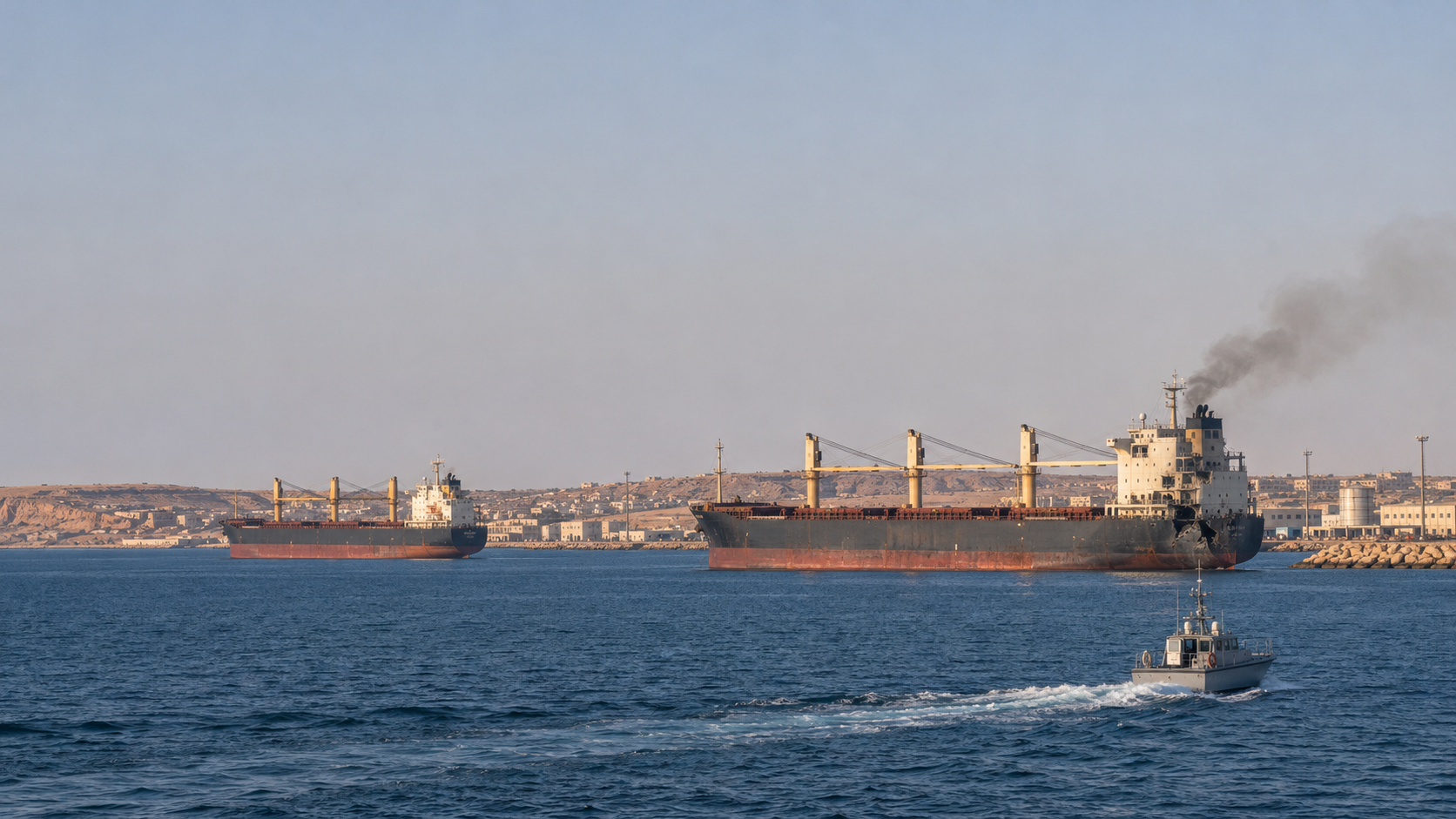 Ukraine Calls Reported Libya Ship Attack Self-Defence
-
 Two Arrested After Suspected Burglary at Royal Norfolk Home
-
 What the Unsealed Ilhan Omar Search Records Show
-
 China Investigates Shanghai Party Chief Chen Jining
-
 Japan Defends ICC Despite U.S. Opposition
-
 Haitian Families Facing Separation at the Canadian Border
-
 Thanksgiving Nor’easter: Rain, Wind, and Travel Risks
-
 Morning Brief: Huang, Iowa Detonation and Hormuz Tolls
-
 Bay Area King Tide Flooding: Road Closures and Updates
-
 Trump Calls for Faster Federal Executions, Criticizes Newsom
-
 Judge Required Safeguards Before Omar Home Search
-
 U.S. Adds Megaspeed to Trade Blacklist Over Nvidia Concerns
-
 San Francisco Sewers Overwhelmed by Intense Rain
-
 Gaza Strike Kills UNRWA Water Worker, Two Others
-
 What COP31’s Failure Reveals About a Divided World
-
 Pauline Hanson Faces State Election Test Over Debt